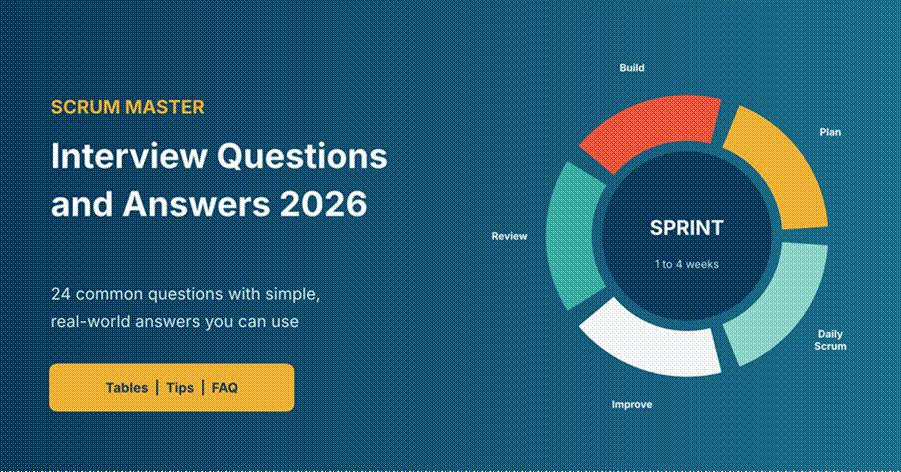
Prepare for your Scrum Master interview with 24 common questions and simple answers. Includes tables, sample answers, tips and an FAQ for 2026.
Getting ready for a Scrum Master interview can feel hard. You know the basics, but the questions keep changing. One panel asks you to explain a Sprint. The next one asks what you would do if your Product Owner keeps changing the plan in the middle of a Sprint.
This guide covers 24 questions that come up again and again in 2026. Each one has a short, simple answer that you can say in your own words. You will also find a table of Scrum events, a list of questions you can ask the interviewer, and an FAQ at the end.
What Interviewers Really Want to Know
Most interviewers already know that you can read the Scrum Guide. They want to find out something else. They are checking if you can:
- Coach a team, and not just run meetings
- Stay calm when a Sprint goes wrong
- Share real stories from real teams
- Say no to bad habits in a kind but firm way
- Work with remote teams and new tools, including AI
Keep this in mind while you read the answers below. A good answer is short, honest and has an example.
Part 1: Basic Scrum Master Interview Questions
1. What is Scrum?
Scrum is a simple framework that helps small teams solve hard problems. The team works in short cycles. They build a little, show it, get feedback and then improve. It stands on three ideas: be open about the work, check the work often, and change direction when needed.
2. What does a Scrum Master do?
A Scrum Master helps the team use Scrum well. They coach the team, remove blocks, and keep the events useful. They also help the rest of the company understand Scrum. A Scrum Master is not a boss and not a project manager. The easiest way to say it: a coach, not a manager.
3. What are the three accountabilities in a Scrum Team?
A Scrum Team has one Product Owner, one Scrum Master and Developers. The Product Owner decides what is most valuable to build. The Developers build it. The Scrum Master helps everyone work well. Together they are one team with one goal.
Small tip: the 2020 Guide says “accountabilities”, not “roles”. Using the right word shows that you read the latest guide.
4. What is a Sprint?
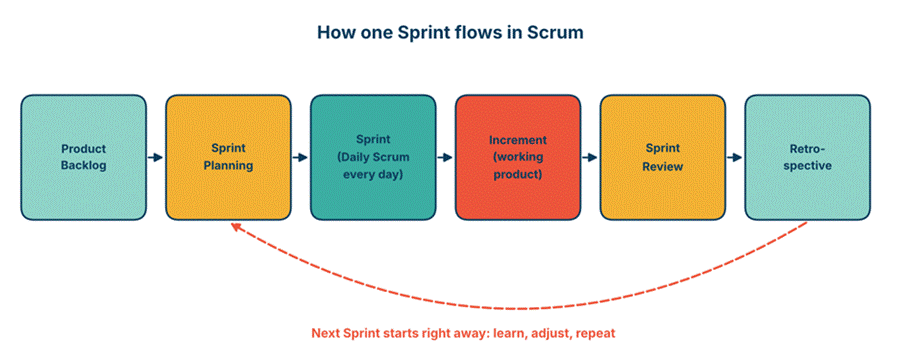
A Sprint is a fixed period of one month or less. In this time the team turns ideas into a working piece of the product. Most teams pick two weeks. When one Sprint ends, the next one starts right away.
5. What are the five Scrum events?
The five events are the Sprint, Sprint Planning, the Daily Scrum, the Sprint Review and the Sprint Retrospective. The table below shows the time limits for a one-month Sprint. Shorter Sprints have shorter events.
| Event | Time limit | What it is for |
| Sprint | 1 month or less | Holds all the other events. The real work happens here. |
| Sprint Planning | 8 hours | Pick what to build and decide how to build it. |
| Daily Scrum | 15 minutes | Check progress toward the Sprint Goal and plan the next 24 hours. |
| Sprint Review | 4 hours | Show the work to stakeholders and get their feedback. |
| Sprint Retrospective | 3 hours | Look at how the team worked and pick ways to improve. |
6. What are the three Scrum artifacts?
Each artifact has one commitment that keeps it clear and focused:
- Product Backlog: the list of things the product may need. Its commitment is the Product Goal.
- Sprint Backlog: the work picked for this Sprint. Its commitment is the Sprint Goal.
- Increment: the finished, usable work. Its commitment is the Definition of Done.
7. What is the Definition of Done?
It is a clear checklist that tells everyone when work is truly finished. For example: the code is reviewed, tests pass and it is ready to release. The whole team owns it. If an item does not meet the list, it is not part of the Increment. In 2026, many teams also add security and accessibility checks.
8. What are the five Scrum values?
Commitment, Focus, Openness, Respect and Courage. Do not just list them. Pick one and give an example. For courage, you could say: “I told a senior manager that the deadline was not realistic, and I brought facts to show why.”
Part 2: Questions About Working With the Team
9. What is the difference between Agile and Scrum?
Agile is a way of thinking. It values working software, teamwork and quick response to change. Scrum is one way to practise it. Kanban and XP are others. Simply put, Agile is the “why” and Scrum is one “how”.
10. What is the Product Backlog and who owns it?
It is an ordered list of everything the product might need. It is never finished, because it changes as the team learns. The Product Owner is accountable for it, but anyone can suggest items. The items at the top should be small and clear enough for the next Sprint.
11. What is velocity? Should we use it to compare teams?
Velocity is the amount of work a team finishes in a Sprint, often counted in story points. It helps with planning. But never use it to compare teams, because points mean different things to different teams. A fun fact: velocity is not even mentioned in the Scrum Guide.
12. What is a Sprint Goal and why does it matter?
A Sprint Goal is one clear reason for the Sprint, such as “let users pay by UPI”. It gives the team focus. The team can change the small details of the work and still stay on track.
13. How do you run a good Daily Scrum?
The Daily Scrum is for the Developers. It takes 15 minutes at the same time and place each day. The team looks at progress toward the Sprint Goal and plans the next 24 hours. It is not a status report for the Scrum Master or a manager. Long technical talks happen after the meeting.
14. What is the difference between Scrum and Kanban?
| Scrum | Kanban | |
| Work cycle | Fixed Sprints | Continuous flow |
| Roles | Product Owner, Scrum Master, Developers | No roles required |
| Changes during work | Avoided inside a Sprint | Allowed at any time |
| Main focus | Sprint Goal and a usable Increment | Limiting work in progress and speeding up flow |
15. How do you handle a team member who does not want to follow Scrum?
I would listen first. Resistance usually has a reason, like a bad past experience or too many meetings. I would ask questions instead of giving orders. Then I would suggest a small experiment, such as a shorter Daily Scrum for two weeks. When people see a real result, they often change their mind on their own.
16. What happens if the team misses the Sprint Goal?
It is not a disaster. It is information. I would talk about it openly in the Retrospective without blaming anyone. Was the goal too big? Was the work unclear? Did something surprise us? Unfinished work goes back to the Product Backlog. Then the team picks one thing to change in the next Sprint.
Part 3: Situational Questions
These are the questions that decide most interviews. There is no perfect answer, so explain your thinking step by step.
17. The Product Owner keeps changing priorities in the middle of a Sprint. What do you do?
I would protect the Sprint Goal first. Small changes that do not hurt the goal can be talked about with the Developers. Big new work should wait for the next Sprint. If the goal is no longer useful, only the Product Owner can cancel the Sprint. I would also ask why the changes keep coming, since the Product Owner is often under pressure from stakeholders.
18. Two Developers keep arguing. What do you do?
I would not pick a winner. First I would talk to each person alone to understand their side. Then I would bring them together around the shared goal and help them look at facts, not opinions. If it keeps happening, I would raise it as a team topic in the Retrospective. I step in more only if the team cannot solve it.
19. The team hits its velocity, but stakeholders are unhappy. Why?
The team may be delivering output but not value. I would check if stakeholders come to the Sprint Review and if they see real progress. Then I would help the Product Owner link each Sprint to a customer need. I would also track results like usage and feedback.
20. Your Daily Scrum takes 30 minutes. How do you fix it?
Usually the team slips into technical problem-solving. I would remind everyone of the purpose, and try walking through the board item by item. Deep talks move to “after the Daily Scrum”. I would also ask if the real problem is unclear work, not the meeting.
21. Tell me about a time you failed.
Use the STAR method. It keeps your story short and clear:
- Situation: “My team missed three Sprint Goals in a row.”
- Task: “I needed to find out why, without blaming anyone.”
- Action: “I ran a Retrospective on just that problem. We found that work was too big. We started splitting stories smaller.”
- Result: “The next four Sprints met their goals, and I learned to ask about work size earlier.”
Change the details to match your own story. Never blame others, and always end with what you learned.
Part 4: New Questions for 2026
22. How do you run Scrum with a remote team?
Remote Scrum needs more care, not more meetings. I keep events short, use a shared board and write decisions down so people in other time zones can catch up. I rotate meeting times so the same people are not always up late.
23. How would you use AI tools as a Scrum Master?
AI can save time on small chores, like summarising Retrospective notes, drafting user stories or spotting patterns in past Sprints. But it cannot replace judgment or coaching. I would keep people in charge of decisions and check everything the tool writes. I would also make sure the Definition of Done includes a human review of AI-written code.
24. How do you know you are doing a good job as a Scrum Master?
I look at the team, not at my own activity. Does the team meet its Sprint Goals more often? Are Retrospective actions getting done? Are customers happier? Does the team need me less for basic things?
Weak Answer vs Strong Answer
Small word choices can change how your answer sounds. Here are three common examples:
| Weak answer | Strong answer | Why it works |
| “The Scrum Master runs the Daily Scrum.” | “The Developers run it. I make sure it happens and stays useful.” | Shows you know the Guide |
| “Velocity shows how good a team is.” | “Velocity helps with planning. I also look at Sprint Goals and customer results.” | Shows you think about value |
| “I would tell the team to follow the rules.” | “I would ask why they struggle and try a small experiment.” | Shows coaching, not control |
Do You Need a Scrum Certification?
Not always, but many job posts ask for one. It also helps if you are new to the role. These are the three most common:
| Certification | Offered by | Good to know |
| PSM I | Scrum.org | Tests how well you know the Scrum Guide. It does not expire. |
| CSM | Scrum Alliance | Needs a training course first. It must be renewed every two years. |
| SAFe Scrum Master | Scaled Agile | Useful if the company uses the SAFe framework for many teams. |
A certificate gets you the interview. Your stories get you the job.
Questions You Can Ask the Interviewer
At the end, you will almost always hear, “Do you have any questions for us?” Always say yes. Here are five good ones:
- What would my first 30 days look like?
- How would you describe the team: how long they have worked together and how mature they are?
- Do leaders here see the Scrum Master as a coach or as a delivery manager?
- How do you measure success for this role?
- What is the biggest problem the team faces right now?
5 Mistakes to Avoid
- Learning answers by heart. Interviewers can tell. Use your own words.
- Saying “I would tell the team to…” A Scrum Master guides and asks questions.
- Having no stories. Prepare three real examples: a conflict, a failure and a win.
Frequently Asked Questions
Is there a new Scrum Guide in 2026?
No. The 2020 Scrum Guide is still the current official version. Community add-ons exist, but exams and most employers use the 2020 guide.
How long should I prepare for a Scrum Master interview?
If you already work in Scrum, one week of focused practice is a good start. If Scrum is new to you, plan for three to four weeks. Spend most of that time on stories and situational questions.
Does a Scrum Master need to know how to code?
No. But you should understand how software is built, tested and released. That helps you spot real problems and earn the trust of the Developers.
Can a fresher become a Scrum Master?
Yes. Many start as team leads, testers, business analysts or project coordinators. A certification and a few good examples of helping a team improve can open the door.
Final Words
A strong Scrum Master interview is not about perfect definitions. It is about showing that you care about the team, think clearly and learn from mistakes. Practise these 24 questions out loud, add your own stories, and keep your answers short.
You can read the official Scrum Guide for free at scrumguides.org. Good luck with your interview!