Preparing for an HR Generalist interview? Here are 25+ common questions with simple sample answers, tips, and a quick checklist to help you get hired.
So you have an HR Generalist interview coming up. Maybe you are excited. Maybe you are a little nervous. Both are normal. The good news is that most HR interviews follow a pattern. Once you know the pattern, the questions get a lot easier.
In this guide, I have put together the questions that come up again and again, along with simple sample answers you can change to fit your own story. You will also find a few tips on how to answer, what to avoid, and what to ask the interviewer at the end.
Don’t memorize the answers word for word. Interviewers can tell when you are reading from a script. Use the samples as a starting point, then add your own examples.
What Does an HR Generalist Do?
Before you answer any question, be clear about the job itself. An HR Generalist is the all-rounder of the HR team. Instead of working in one small area, you handle a bit of everything. One day you might be posting a job ad. The next day you might be explaining leave rules to a worried employee.
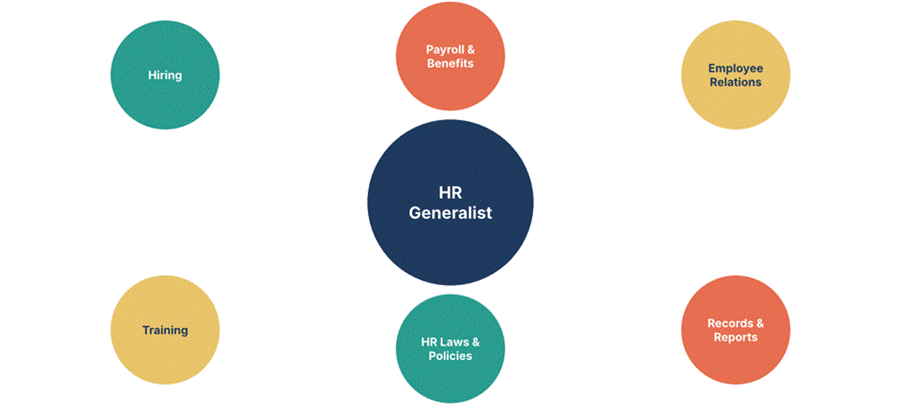
The main areas an HR Generalist works in
Because the role is so wide, interviewers want to see three things: that you know the basics of every HR area, that you can stay calm with people, and that you can keep things fair and legal.
How Does an HR Generalist Interview Usually Go?
Most companies use two or three rounds. The first round is often a short phone call with a recruiter. The second is with the HR manager or a senior HR person. A final round may include the department head you would support.
| Question Type | What They Want to Learn | How to Prepare |
| Basic and background | Who you are and why you want this job | Practice a short story about your career |
| HR knowledge | Do you know hiring, pay, laws and policies | Revise the basics of each area |
| Behavior questions | How you acted in real situations | Have 4 or 5 real examples ready |
| Situation questions | How you would handle problems | Think about fairness, rules and kindness |
| Your questions | Are you really interested in the company | Write 3 or 4 good questions |
Basic HR Generalist Interview Questions
Q1. Tell me about yourself.
“I have worked in HR for four years. I started as an HR assistant, where I handled records and joining forms. Later I moved into hiring and employee queries, and for the last two years I have looked after about 150 employees. I like this work because I get to help people and the business at the same time. That’s why this role caught my eye.”
Tip: Keep it under one minute. Talk about your past, your present, and why you want this job. Skip your childhood and hobbies unless they matter here.
Q2. Why do you want to be an HR Generalist?
“I enjoy variety. In a generalist role, no two days look the same. I like being the person employees come to when they have a question, and I like helping managers make good people decisions. I also want to grow into a senior HR role one day, and this job gives me a view of every part of HR.”
Q3. What are the main duties of an HR Generalist?
“It covers the full employee journey. That means hiring and onboarding, keeping employee records, helping with payroll and benefits, handling leave and attendance, solving employee problems, running training, and making sure the company follows labour laws.”
Q4. What are your strengths and weaknesses?
“My strength is that I listen well. People tell me things they would not tell others, and that helps me solve problems early. My weakness is that I used to take on too much work myself. I have learned to make a daily task list and ask for help when I need it.”
Tip: Pick a real weakness and show what you are doing to fix it. Never say “I work too hard.” Everyone says that, and it sounds fake.
Hiring and Recruitment Questions
Q5. Walk me through your hiring process.
“First I meet the manager to understand the role and the skills needed. Then I write the job post and share it on job sites and social media. I go through the resumes, call the best ones for a short chat, and then set up interviews with the manager. After that I check references, prepare the offer, and plan the first week for the new person so they feel welcome.”
Q6. How do you find good candidates when few people apply?
“I try more than one place. I ask current employees for referrals, search on professional networks, and reach out to people directly. I also look at the job post itself. Sometimes a long list of must-haves scares people away, so I check if the post is clear and honest.”
Q7. How do you make sure hiring is fair?
“I use the same questions for every candidate for a role, and I score answers using a simple sheet. I focus on skills and experience, not on age, gender, religion or background. It also helps to have more than one person in the interview.”
Q8. What would you do in a new employee’s first 30 days?
“Before day one, I’d send a welcome message and get their laptop, email and desk ready. On day one, I’d give a short tour and introduce the team. During the first month I’d do check-ins every week to ask what is going well and what is confusing. Good onboarding helps people stay longer.”
Employee Relations Questions
Q9. How do you handle a conflict between two employees?
“I talk to each person alone first, and I listen without taking sides. Then I find out what the real problem is, because it’s often different from what people say at first. If it’s small, I bring them together to talk it out. If it breaks a company rule, I follow the formal process and write everything down.”
Q10. An employee tells you something private. What do you do?
“I keep it private, but I’m honest about the limits. If it’s about safety, harassment or something that breaks the law, I must act on it. I tell the employee that early so they are not surprised.”
Q11. How do you deal with a manager who ignores HR advice?
“I would meet them privately and explain the risk in simple words, like what could happen if the rule is not followed. I try to show how the advice helps them, not just the rules. If it is serious, I would take it to my HR head.”
Q12. How do you keep employees happy and reduce people leaving?
“I’d start by asking. Short surveys and exit interviews show a lot. Then I’d look for patterns. If many people leave one team, maybe the manager needs support. Small things also matter, like fair pay, thanks for good work, and a clear path to grow.”
HR Knowledge, Laws and Payroll Questions
Q13. How do you stay updated on labour laws?
“I follow government labour department updates, read HR newsletters, and attend webinars. When a rule changes, I check with our legal advisor and update our policy and tell managers what it means for them.”
Q14. What is the difference between a policy and a procedure?
“A policy tells you what the rule is and why it exists. A procedure tells you the steps to follow. For example, the leave policy says how many days people get. The leave procedure shows how to apply and who approves.”
Q15. How do you handle payroll mistakes?
“I first confirm the mistake and the amount. Then I tell the employee quickly and honestly, fix it in the next payroll or with a special payment if needed, and find out why it happened so it doesn’t repeat. Pay mistakes hurt trust fast, so speed and honesty matter.”
Q16. What HR software have you used?
“I have used tools for attendance, payroll and employee records, along with spreadsheets for reports. I learn new software fast, and I always check the numbers by hand the first few times.”
Tip: Be honest here. If you haven’t used a tool, say so and explain how quickly you learned the others.
Behavioral Questions (Use the STAR Method)
Behavioral questions start with phrases like “Tell me about a time when…” They want a real story. The easiest way to answer is the STAR method.
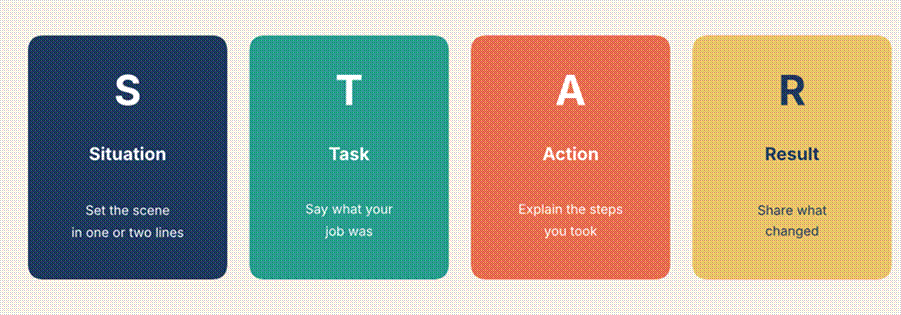
The STAR method keeps your answers clear and short
Q17. Tell me about a time you handled a difficult employee.
“(Situation) An employee in our team was often late and other people were getting upset. (Task) I had to fix this without hurting the relationship. (Action) I met him privately and asked what was going on. He told me his commute had changed. We agreed on a shifted work time and a clear check-in after a month. (Result) He was on time from then on, and the team’s mood improved.”
Q18. Tell me about a time you made a mistake.
“Once I sent a wrong joining date in an offer letter. I noticed it the same day, called the candidate, said sorry, and sent a corrected letter. After that I added a second check before any offer goes out. It never happened again.”
Q19. Describe a time you had to deliver bad news.
“I had to tell a team that a bonus would be delayed. I did not hide it. I met them together, explained the reason, gave the new date, and answered their questions. People were not happy, but they said they respected the honesty.”
Q20. Tell me about a time you worked under pressure.
“During a hiring push, we had to fill 12 roles in six weeks. I made a simple tracker, split the work with a colleague, and set up group interviews. We filled 11 roles on time and the last one a week later.”
Situational Questions
These start with “What would you do if…?” There is rarely one perfect answer. Interviewers look at how you think. A good rule is to stay fair, follow the rules, and talk to people kindly.
Q21. What would you do if an employee says they are being harassed?
“I’d take it seriously right away. I would listen, write down the details, keep it private, and follow the company’s complaint process. If needed, I’d make sure the employee is safe while the matter is checked. I would never ignore it or judge before the facts are clear.”
Q22. What would you do if two managers want the same person for their teams?
“I would talk to both managers and the employee. I’d look at business needs and what the employee wants. Then I’d help the managers agree on a fair plan, maybe even a split of time.”
Q23. What if you find out an employee is lying on their resume?
“I’d collect proof first, because a mistake is not the same as a lie. Then I would speak to the employee, hear their side, and follow the company policy, which could range from a warning to ending the job if the lie is serious.”
Questions You Can Ask the Interviewer
At the end, they will ask, “Do you have any questions?” Always say yes. Good questions show you care. Here are a few ideas:
- How big is the HR team, and who would I work with most?
- What are the biggest people challenges the company faces right now?
- How do you measure success for this role in the first six months?
- Which HR software does the team use?
- What does growth look like for someone in this role?
Avoid asking about salary or holidays in the first round, unless they bring it up.
Do’s and Don’ts on Interview Day
| Do | Don’t |
| Use real examples from your work | Make up stories you can’t explain |
| Keep answers short, around one to two minutes | Talk for five minutes without a break |
| Speak well of past employers | Complain about old bosses or teams |
| Show you can keep things private | Share names or private details from past jobs |
| Dress neat and arrive 10 minutes early | Look at your phone during the talk |
Quick Preparation Checklist
- Read the job post twice and mark the skills they ask for
- Learn about the company: its size, products and culture
- Write down 5 real stories from your work (use STAR)
- Revise basic labour laws for your country and state
- Practice your answers out loud, or with a friend
- Print or carry extra copies of your resume
- Plan your trip so you arrive early
Frequently Asked Questions (FAQ)
What skills do HR Generalists need most?
Good communication, listening, fairness, basic knowledge of labour laws, and the ability to handle many tasks at once. Comfort with simple software like Excel and HR systems also helps.
How should a fresher prepare for an HR Generalist interview?
Learn the basics of hiring, payroll, leave and employee relations. Use examples from internships, college projects or part-time jobs. Show that you learn fast and are willing to listen.
How much does an HR Generalist earn?
It depends on the country, city, company size and your experience. In India, freshers often start at a modest pay and move up with a few years of experience. Check recent job sites for your own city to get a fair range.
What is the difference between an HR Generalist and an HR Specialist?
A generalist handles many HR areas at a basic to medium level. A specialist focuses on one area, such as payroll or hiring, and knows it in great depth.
Do I need an HR certificate to get the job?
Not always. A degree in HR or business helps, and certificates can make your resume stronger. But employers care a lot about real examples and how you deal with people.
How long should my answers be?
Aim for one to two minutes. That is long enough to give a clear example and short enough to keep the interviewer interested.
Final Thoughts
An HR Generalist interview is really a chat about how you treat people and how you solve problems. You don’t need fancy words. You need honest, clear answers backed by real examples.
Pick five or six questions from this list, write your own answers, and say them out loud a few times. By the day of the interview, you’ll feel much more ready. Good luck, and go in with confidence.