29 Azure data engineering interview questions with simple answers for 2026. Covers Data Factory, Spark, Synapse, Microsoft Fabric, SQL and scenarios.
If you have an Azure data engineer interview coming up, you are probably worried about two things. What will they ask? And how much of it is Microsoft Fabric now? Both are fair worries. The job has changed a lot in the last two years, and the interview questions have changed with it.
This guide covers the questions that come up most often in 2026. Each one has a short answer you can say out loud. I kept the answers simple on purpose, because interviewers like clear thinking more than big words.
What Changed for Azure Data Engineers in 2026
Before the questions, here is the background. It helps you sound current in the room.
- DP-203 is gone. Microsoft retired the Azure Data Engineer Associate exam on March 31, 2025. The new one is DP-700, which gives you the Fabric Data Engineer Associate badge. There is no automatic upgrade between the two.
- Fabric is where the new work goes. Azure Synapse still works, and no end date was announced as of June 2026. But it is in maintenance mode and Microsoft is putting its new effort into Fabric.
- Old tools are still everywhere. Lots of companies still run Azure Data Factory, Databricks and Synapse. So you need to know the old and the new.
In short, most interviews now mix three things: classic Azure services, strong SQL and Spark, and a little Fabric.
What Interviewers Actually Test
| Round | What they check | Example question |
| Basics | Core ideas | What is the difference between ETL and ELT? |
| Tools | Hands-on skill with Azure | How would you build an incremental load in Data Factory? |
| Coding | SQL and PySpark | Remove duplicate rows and keep the latest one |
| Design | How you think about problems | Design a daily sales load into a dashboard |
| Behaviour | Teamwork and ownership | Tell me about a pipeline that failed and what you did |
Basic Azure Data Engineering Questions
1. What does an Azure data engineer do?
I build and look after the systems that move data from where it is created to where people use it. That means collecting it, cleaning it, storing it, and getting it ready for reports and models. I also watch the jobs, fix failures, and keep an eye on cost and security.
2. What is the difference between ETL and ELT?
In ETL, you change the data before you load it into the target. In ELT, you load the raw data first and change it inside the target, using its power. ELT is more common on Azure today, because lakes and Spark are cheap and strong.
3. Data lake vs data warehouse: what is the difference?
A data lake holds any kind of data in raw form. It is cheap and flexible. Azure Data Lake Storage and OneLake are examples. A data warehouse holds clean, structured tables that are built for fast SQL. A lakehouse mixes both ideas, and it is the popular choice right now.
4. What is Azure Data Lake Storage Gen2?
It is storage built on top of Azure Blob Storage, with real folders and folder-level permissions added. That makes it fast and easy to manage for big data. Most Azure data projects use it as the main store.
5. What is the medallion architecture?
It splits your data into three layers. Bronze is the raw copy. Silver is cleaned and joined. Gold is ready for reports. The big benefit is safety: if something breaks, you can go back to the raw layer and rebuild.
6. Batch vs streaming: when do you use each?
Batch handles data in chunks on a schedule, like every night. Streaming handles events as they arrive, within seconds. Use batch for daily reports. Use streaming for things like fraud alerts or live dashboards. On Azure, people use Event Hubs, Stream Analytics or Spark Structured Streaming for this.
Azure Data Factory Interview Questions
7. What is Azure Data Factory?
It is a cloud service for building data pipelines with little or no code. It moves data between systems and runs steps on a schedule or when an event happens. It is mainly an orchestrator. It tells other tools what to do and when.
8. What are pipelines, activities, datasets and linked services?
- Pipeline: a group of steps that run together.
- Activity: one step, such as copying data or running a notebook.
- Dataset: points to the data you want to use.
- Linked service: the connection details, like a connection string.
9. What is an integration runtime?
It is the compute that Data Factory uses to move data and run activities. There are three kinds. The Azure one works in the cloud. The self-hosted one reaches on-premises or private networks. The Azure-SSIS one runs old SSIS packages.
10. How do you load only the new data?
The usual way is a watermark. You save the last loaded value, such as the last modified date, in a small table. Each run reads only the rows newer than that value, loads them, and then updates the watermark. Other options are change data capture or a Delta MERGE.
11. How do you handle pipeline failures?
I set retries on the steps that can fail for small reasons, like a network blip. I add a failure path that sends an alert through Azure Monitor. I also send bad rows to an error folder instead of stopping everything. Most important, I make the pipeline safe to run twice, so a rerun does not create duplicates.
12. How do you keep passwords and keys safe?
I store secrets in Azure Key Vault and use managed identity wherever I can. That way no password ever sits in the code or in the pipeline.
Databricks, Spark and Synapse Questions
13. What is Apache Spark and why do we use it?
Spark splits big data across many machines and processes it in memory. That makes it much faster than older tools on large data. You write it with PySpark or Spark SQL.
14. What is Delta Lake?
It is a layer on top of Parquet files that adds transactions, updates, deletes and time travel. In simple words, it makes a pile of files behave like a proper database table. Fabric tables use the Delta format too.
15. Repartition vs coalesce: what is the difference?
Repartition can raise or lower the number of partitions, and it shuffles all the data. Coalesce can only lower the number, and it avoids a full shuffle, so it is cheaper. I use coalesce when I want to write fewer files.
16. What is data skew and how do you fix it?
Skew means a few keys have far more rows than the rest, so one machine does most of the work and the job crawls. You can fix it by salting the key, using a broadcast join when one table is small, or turning on adaptive query execution.
17. Synapse or Databricks: which one would you pick?
Databricks has stronger Spark, nice notebooks for teams, and great Delta support. Synapse keeps SQL pools, Spark and pipelines in one place. In 2026 I would be careful starting a brand-new project on Synapse, since Microsoft’s new investment is going to Fabric. For an existing Synapse system, I would keep it running and plan the move step by step.
Microsoft Fabric Interview Questions (New in 2026)
18. What is Microsoft Fabric?
It is an all-in-one analytics platform that Microsoft launched in 2023. Data Factory, lakehouse, warehouse, notebooks, real-time analytics and Power BI all live in one place, and you pay through one shared capacity.
19. What is OneLake?
Think of it as OneDrive for data. It is one storage place for the whole company. Data is kept in open formats like Delta and Parquet, so every Fabric tool can use the same copy.
20. What is a shortcut?
A shortcut is a pointer to data that sits somewhere else, like another lakehouse or an ADLS account. You can use that data without copying it, which saves time and storage.
21. Lakehouse or warehouse in Fabric?
A lakehouse suits Spark work and any file type, so engineers like it. A warehouse gives you full T-SQL and suits SQL-first teams. Both keep their data in OneLake.
22. How is Fabric Data Factory different from Azure Data Factory?
This is a favourite question in 2026. The names are similar, but the setup is not. Here is a quick view.
| Area | Azure Data Factory | Fabric Data Factory |
| Type | PaaS service you set up in the Azure portal | SaaS, lives inside a Fabric workspace |
| Pricing | Per activity run, data movement and runtime hours | Paid through Fabric capacity |
| On-premises access | Self-hosted integration runtime | On-premises data gateway |
| Transformation | Mapping data flows | Dataflow Gen2 (built on Power Query) |
| SSIS packages | Azure-SSIS runtime | Not available yet |
| Best for | Existing Azure setups | New projects on Fabric |
Two details impress interviewers. First, ADF data flows and Fabric dataflows are not compatible, so you rebuild them when you move. Second, CDC items from ADF become Copy jobs in Fabric. A simple rule of thumb: start new projects in Fabric, and move old ones when there is a good reason.
SQL and Coding Questions
23. How do you remove duplicates and keep the latest row?
Use ROW_NUMBER inside a subquery and keep row number one.
SELECT *
FROM (
SELECT *,
ROW_NUMBER() OVER (
PARTITION BY customer_id
ORDER BY updated_at DESC) AS rn
FROM customers
) t
WHERE rn = 1;
24. ROW_NUMBER vs RANK vs DENSE_RANK?
ROW_NUMBER gives every row a unique number. RANK gives ties the same number and then skips ahead. DENSE_RANK gives ties the same number and does not skip.
25. What is SCD Type 2?
It keeps the full history of a record. When a value changes, you close the old row with an end date and add a new row with a start date. In Delta tables you usually do this with a MERGE statement.
Scenario-Based Questions
These questions have no single right answer. The interviewer wants to hear how you think. Walk through your steps slowly and say why you pick each one.
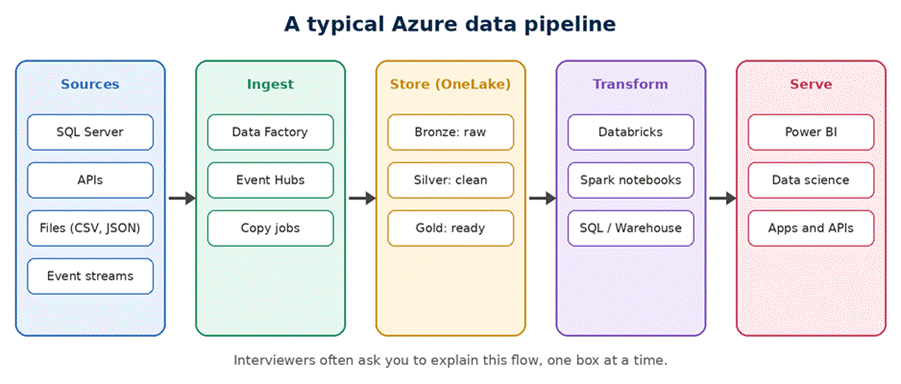
A simple pipeline you can sketch in any interview.
26. A job that used to take 30 minutes now takes 3 hours. What do you check?
- Look at the run history in the monitoring tab. Find out when it started to slow down.
- Check if the data volume jumped or if one key has become skewed.
- Check the source system. Sometimes the source is the slow part.
- Check the cluster size or Fabric capacity for throttling.
- Ask if anyone changed the code or the schema recently.
27. Design a daily load from on-premises SQL Server to a Power BI report.
I would connect through a self-hosted runtime or a gateway. Then I would copy only the new rows with a watermark into the Bronze layer. A Spark or SQL job cleans the data into Silver, and a second job builds summary tables in Gold. Power BI reads from Gold. Secrets go in Key Vault, and alerts go to the team if anything fails.
28. Bad data got into the reports. How do you stop that from happening again?
I add checks between Bronze and Silver, such as null checks, duplicate checks and range checks. Rows that fail go to a quarantine table, not to the report. Because I always keep the raw layer, I can fix the rule and reload the data.
29. How do you cut cloud cost on a data platform?
Turn on auto-pause and autoscale. Use the smallest cluster that finishes on time. Avoid thousands of tiny files by compacting them. Delete data nobody uses. In Fabric, watch how much capacity each job eats and move heavy jobs to quiet hours.
How to Prepare in 4 Weeks
| Week | What to do |
| Week 1 | SQL daily: joins, window functions, CTEs, group by. Solve at least two problems every day. |
| Week 2 | Learn Data Factory and ADLS. Build one real incremental pipeline, even a small one. |
| Week 3 | Practice Spark and Delta in Databricks or Fabric. Write PySpark by hand, not only copy and paste. |
| Week 4 | Study Fabric basics, do mock interviews, and say your answers out loud. |
A few tips that work better than any cheat sheet:
- Build one project end to end and learn its story. Interviewers love real examples more than perfect definitions.
- Know your numbers. How big was the data? How long did the job run? How much did you save?
- Say it is fine not to know. “I haven’t used that, but here is how I would find out” is a strong answer.
- Skip exam dump sites. They break Microsoft’s exam rules and they will not teach you the skill that the interviewer is testing.
If you want proof of skill, DP-700 is the current exam to aim for. It is not a must for every job, but it shows you know the Fabric side.
Frequently Asked Questions
Is Azure Data Factory still worth learning in 2026?
Yes. Many companies still run it, and the ideas carry over to Fabric Data Factory. Learn ADF first, then see what changes in Fabric.
Do I need to learn Microsoft Fabric for interviews?
You need the basics at least: OneLake, lakehouse, warehouse, pipelines and shortcuts. If the job is on a new project, expect deeper Fabric questions.
Can I still take the DP-203 exam?
No. It was retired on March 31, 2025. The current exam is DP-700.
Which language should I learn first?
SQL, without a doubt. After that, learn Python and PySpark. Almost every interview has SQL questions.
How long does it take to prepare?
If you already know SQL, four to eight weeks of steady practice is enough for most people.
What should freshers focus on?
SQL, basic Azure ideas like ADLS and Data Factory, and one small project that you can explain clearly.
Final Thoughts
Azure data engineering interviews in 2026 reward people who know the basics well and can explain them simply. You do not need to know every service. Pick the core ones, build something real, and practice saying your answers. If you do that, most of these questions will feel familiar by the time you sit down.