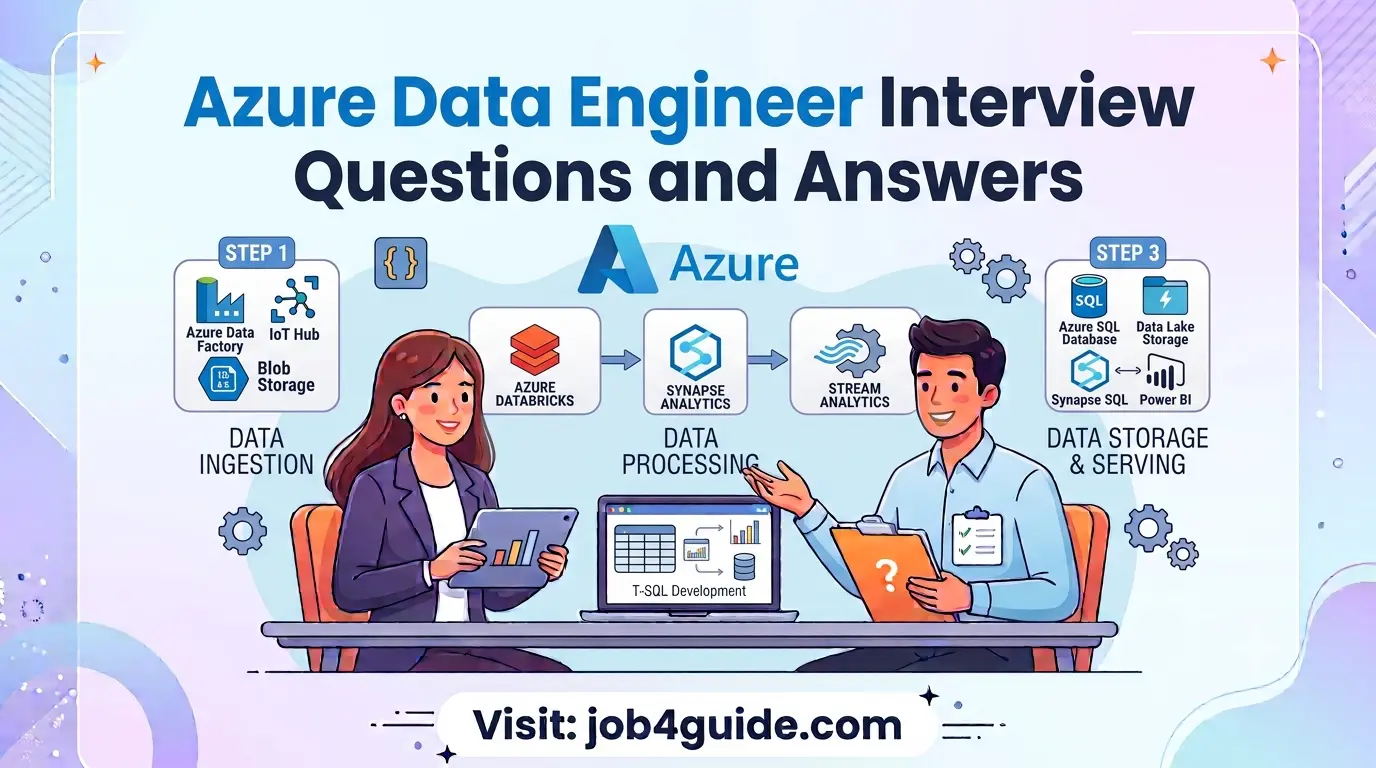
This guide has 25+ real Azure data engineer interview questions with short, simple answers. It covers Azure Data Factory, Synapse, Databricks, Delta Lake, SQL, security and scenario questions.
What Do Interviewers Look For in 2026?
Most companies now use Azure with a lakehouse setup. That means they want people who can build pipelines, keep data clean, and keep costs low. Here is what usually gets checked:
- SQL: joins, window functions, and query tuning.
- Python or PySpark: reading, cleaning and writing data.
- Azure tools: Data Factory, Data Lake Storage, Synapse, and Databricks.
- Design thinking: how you would build a pipeline from scratch.
- Care about safety and cost: access control, secrets, and saving money.
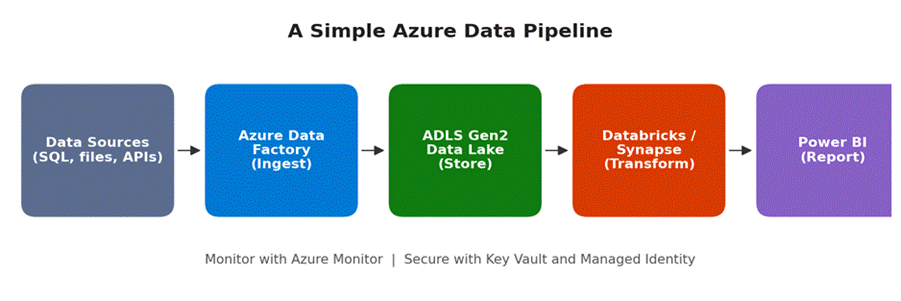
Figure 1: A basic Azure data pipeline. Most interview scenarios follow this same flow.
Basic Azure Data Engineer Interview Questions
Q1. What does an Azure data engineer do?
An Azure data engineer builds and looks after the systems that move and store data. We pull data from many places, clean it, and make it ready for reports or machine learning. We also make sure the pipelines run on time and do not break.
Q2. What is Azure Data Lake Storage Gen2?
It is a storage service built for big data. It sits on top of Blob Storage but adds a folder-like structure called a hierarchical namespace. This makes it faster and easier to manage large files, and it lets you set permissions on folders.
Q3. What is the difference between Blob Storage and ADLS Gen2?
Blob Storage is a flat storage space for any file. ADLS Gen2 is Blob Storage with real folders and better security controls. If you do analytics, pick ADLS Gen2.
Q4. What is the difference between ETL and ELT?
In ETL, you clean the data first and then load it. In ELT, you load raw data first and clean it inside the target system. ELT is more common on Azure today because Synapse and Databricks are strong enough to do the heavy work after loading.
Q5. What is the difference between a data lake and a data warehouse?
| Point | Data Lake | Data Warehouse |
| Data type | Raw, any format | Clean, structured |
| Users | Data engineers, data scientists | Analysts, business teams |
| Cost | Cheaper to store | Costs more |
| Azure example | ADLS Gen2 | Synapse dedicated SQL pool |
Azure Data Factory (ADF) Interview Questions
Q6. What is Azure Data Factory?
ADF is a cloud tool used to move and shape data. You build pipelines with drag and drop, and you can connect to more than 90 data sources. Think of it as the delivery truck of your data system.
Q7. Explain the main parts of ADF.
| Part | Simple meaning |
| Pipeline | A group of steps that run together |
| Activity | One single step, like Copy or Run Notebook |
| Dataset | Points to the data you use |
| Linked service | The connection details, like a connection string |
| Trigger | Decides when a pipeline starts |
Q8. What is an Integration Runtime?
It is the compute that ADF uses to run your work. There are three types: Azure IR for cloud data, Self-hosted IR for on-premises data, and Azure-SSIS IR to run old SSIS packages.
Q9. What types of triggers are in ADF?
- Schedule trigger: runs at a set time, like every night at 2 AM.
- Tumbling window trigger: runs in fixed time slices and can re-run past slices.
- Event-based trigger: runs when a file lands in storage.
- Manual trigger: you start it yourself.
Q10. How do you do an incremental load?
I use a watermark column, like a last modified date. I save the last loaded value in a small control table. On each run, I pull only rows newer than that value, then update the control table when the load finishes. This saves time and money.
Q11. How do you handle pipeline failures?
First, I add retry settings on the activity. Then I set alerts in Azure Monitor so the team knows right away. I also write run details into a log table, so I can find the cause fast. For big loads, I make the pipeline safe to re-run, so a second run does not create duplicates.
Q12. What is a Mapping Data Flow?
It is a no-code way to change data inside ADF. It runs on Spark behind the scenes. You can join, filter, and group data with a visual screen. For very heavy work, most teams still choose Databricks.
Synapse and Databricks Interview Questions
Q13. What is Azure Synapse Analytics?
It is one place for data warehousing, big data, and pipelines. It has SQL pools, Spark pools, and built-in pipelines that look a lot like ADF.
Q14. Dedicated SQL pool vs serverless SQL pool?
A dedicated pool has fixed power that you pay for all the time, and it is good for large, steady workloads. A serverless pool has no setup, and you pay for the data you scan. It is best for quick checks on files in the lake.
Q15. What is Azure Databricks?
It is a fast Apache Spark platform made for teams that write code in Python, SQL or Scala. It is great for large data jobs, streaming, and machine learning.
Q16. What is Delta Lake?
Delta Lake adds a smart layer on top of your data files. It gives you safe updates (ACID), the ability to go back to an old version (time travel), and simple merge and delete commands. Plain Parquet files cannot do this.
Q17. What is the medallion architecture?
It splits data into three layers. Bronze holds raw data as it came. Silver holds cleaned data. Gold holds final data ready for reports. This makes it easy to track problems and fix them.
Q18. What is the difference between repartition and coalesce?
Repartition can increase or decrease the number of partitions, but it shuffles all data, so it is slower. Coalesce only reduces partitions and avoids a full shuffle, so it is faster. I use coalesce before writing small output files.
Q19. What is data skew and how do you fix it?
Data skew means some partitions hold far more data than others, so a few tasks run for a long time. I fix it by using salting (adding a random key), using broadcast joins for small tables, or picking a better partition key.
Q20. Write a query to find the second highest salary.
SELECT MAX(salary) FROM employees
WHERE salary < (SELECT MAX(salary) FROM employees);
You can also use DENSE_RANK() and pick rank 2. Mention both. Interviewers like it when you show more than one way.
Security and Cost Questions
Q21. How do you keep data safe in Azure?
- Store passwords and keys in Azure Key Vault, never in code.
- Use Managed Identity so services can log in without passwords.
- Give the least access needed using RBAC and folder ACLs.
- Use private endpoints so data does not travel on the public internet.
- Data is encrypted at rest and in transit by default.
Q22. How do you reduce cost in Azure data projects?
I turn off Databricks clusters when idle using auto-terminate. I pause dedicated SQL pools at night. I use incremental loads instead of full loads, store old data in cool or archive tiers, and choose the right size of cluster instead of the biggest one.
Scenario Based Questions
These are the questions that decide the interview. Take a breath, and explain your thinking step by step.
Q23. How would you build a daily sales pipeline from an on-premises SQL Server to a dashboard?
I would install a self-hosted integration runtime and use ADF to copy new rows each night into the Bronze layer of ADLS Gen2. Then a Databricks notebook cleans the data into Silver and builds summary tables in Gold. Power BI reads the Gold tables. I would add alerts, a log table, and Key Vault for the passwords.
Q24. Your pipeline was fast last month but is slow now. What do you check?
- Did the data size grow? Check row counts and file counts.
- Are there too many small files? Compact them.
- Is there data skew or a bad join? Look at the Spark UI.
- Did someone change the cluster size or the source system?
Q25. How do you handle Slowly Changing Dimension Type 2?
When a value changes, I do not overwrite the old row. I mark the old row as expired with an end date and add a new row with a start date and a current flag. In Delta Lake, I do this with a MERGE statement.
How to Split Your Prep Time
Many people spend all their time on tools and forget SQL. From my experience, SQL and Data Factory show up in almost every interview, so they deserve the biggest share. Use this as a starting point and change it based on the job post.
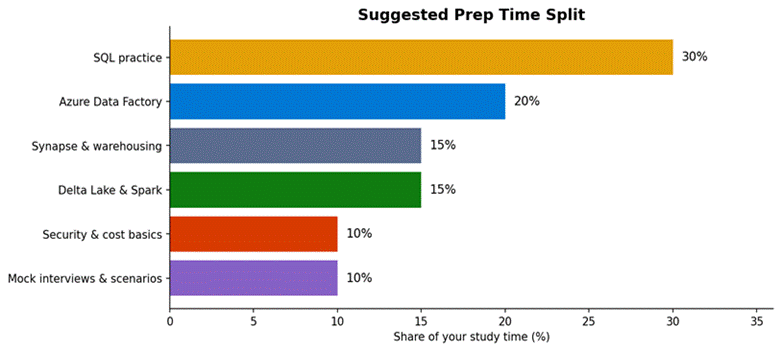
Figure 2: A simple study plan for an Azure data engineer interview.
Quick Tips to Crack the Interview
- Build one small project. For example, load public data into ADLS, clean it in Databricks, and show it in Power BI. You can talk about it for ten minutes.
- Use real examples. Say “In my project, we had a file that came late every Monday, so we…” It sounds honest and strong.
- It is fine to say “I don’t know.” Then explain how you would find out. That shows good thinking.
- Practice out loud. Reading answers in your head is not the same as saying them.
- Read the job post. If it says Synapse, spend more time on Synapse.
- Get a certificate if you can. The DP-203 exam was retired, so check Microsoft Learn for the current data engineering path, such as Fabric Data Engineer Associate (DP-700).
Frequently Asked Questions (FAQ)
Is Azure data engineering a good career in 2026?
Yes. Companies keep moving data to the cloud, and they need people to build and fix pipelines. The demand for good data engineers stays strong.
Which language should I learn first, Python or SQL?
Start with SQL. You will use it every day. Then learn Python, mainly PySpark for Databricks.
Do I need to know Microsoft Fabric?
It helps. Fabric is Microsoft’s newer all-in-one data platform, and many companies are starting to use it. Learn the basics, but keep your Azure Data Factory, Synapse and Databricks skills strong.
How long does it take to prepare?
If you already know SQL, about 6 to 8 weeks of steady study is enough for most people. Beginners may need 3 to 4 months.
What is the most asked topic in interviews?
Azure Data Factory, SQL, and Spark. Also expect at least one scenario question about design or slow pipelines.
Can a fresher get an Azure data engineer job?
Yes, but you need proof. A good project on GitHub and clear basics of SQL and Azure can open the door.
Final Words
You do not need to know every Azure service to do well in an interview. Know the core tools, explain your thinking in simple words, and back it up with one or two real examples. Go through these 25 questions a few times, build a small project, and you will walk in with much more confidence.