If you are going for a data engineer or data analyst job, there is a good chance someone will ask you about Azure Synapse Analytics. Many companies still run their reports and data warehouses on it, so the questions keep coming.
This guide gives you the questions that come up most often in interviews, along with short answers you can say out loud. I have kept the language plain on purpose. In a real interview, clear and simple answers beat fancy words every time.
In this article you will find:
- Basic questions for freshers
- Middle-level questions on SQL pools, Spark and pipelines
- Tuning, security and real-life scenario questions
- A preparation plan and a short FAQ
Part 1: Basic Azure Synapse Interview Questions
1. What is Azure Synapse Analytics?
Azure Synapse Analytics is a Microsoft cloud service that puts data warehousing, big data work and data movement in one place. You can load data, clean it, store it, run SQL on it and build reports without jumping between many tools. It was earlier known as Azure SQL Data Warehouse.
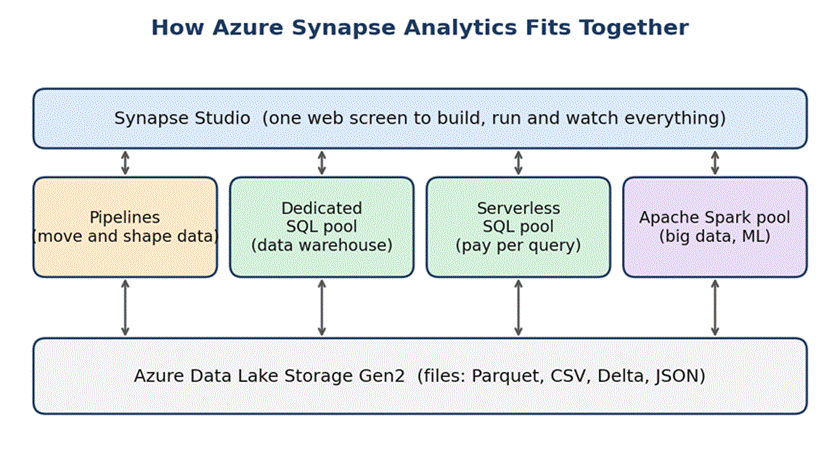
Figure 1: The main parts of Azure Synapse Analytics
2. What are the main parts of Synapse?
- Synapse Studio: the web screen where you build and watch your work.
- Dedicated SQL pool: a fast data warehouse with fixed computing power.
- Serverless SQL pool: lets you query files in the data lake and pay only for what you scan.
- Apache Spark pool: for big data work in Python, Scala or SQL.
- Pipelines: move and change data, just like Azure Data Factory.
- Data Lake Storage Gen2: the place where the files sit.
3. What is the difference between a dedicated SQL pool and a serverless SQL pool?
This is one of the most common questions. Learn this table well.
| Point | Dedicated SQL pool | Serverless SQL pool |
| Storage | Data is stored inside the pool | Data stays in the data lake as files |
| Cost | You pay per hour while it runs | You pay for data scanned (per TB) |
| Setup | You create and size it (DWU) | Ready to use, nothing to size |
| Best for | Large, regular reporting workloads | Quick checks, data exploring, light jobs |
| Speed | Very fast for big joins | Fine for light work, slower for heavy loads |
| Can pause? | Yes, to stop compute cost | Not needed, no idle cost |
4. What is a DWU?
DWU means Data Warehouse Unit. It is the size of your dedicated SQL pool. A bigger DWU gives you more CPU, memory and speed, and also costs more. You can scale up before a heavy load and scale down after it.
5. What is MPP?
MPP means Massively Parallel Processing. Instead of one server doing all the work, many nodes share it. A control node takes your query, splits it into small parts and sends them to compute nodes. Each node works on its own slice of data, and the results are joined at the end. Dedicated SQL pools spread data across 60 pieces called distributions.
Part 2: Middle-Level Questions
6. What are the three table distribution types?
Data in a dedicated SQL pool must be spread across the nodes. You pick one of three ways:
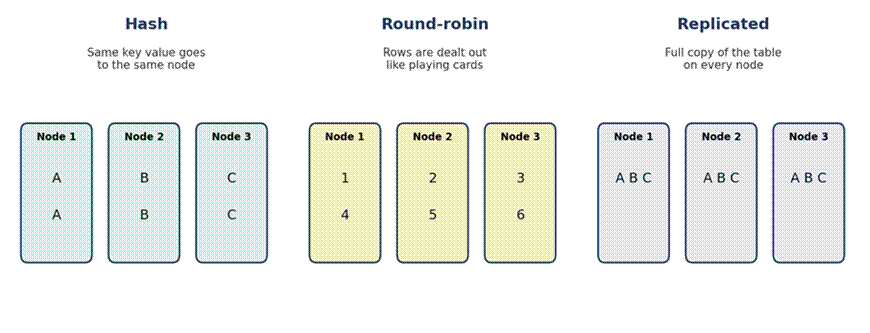
Figure 2: How the three distribution types place your rows
| Type | How it works | Use it when |
| Hash | Rows go to a node based on a key column | Big fact tables that join often |
| Round-robin | Rows are spread evenly with no key | Staging tables and fast loading |
| Replicated | Full copy on every node | Small dimension tables (under about 2 GB) |
7. How do you pick a good hash key?
Choose a column that has many different values, is used often in joins and is not used in the WHERE filter. Do not pick a date column. Most queries ask for one day or one month, so all the work lands on a few nodes while the others sit idle.
8. What is data skew and why is it bad?
Data skew means some distributions hold far more rows than others. The query is only as fast as the slowest node, so one overloaded node slows everything. You can spot it by checking row counts per distribution. The fix is usually a better hash key.
9. What is data movement?
When two tables that are joined are not spread the same way, Synapse must move rows between nodes during the query. This costs time. Common types are shuffle and broadcast. Using the same hash key for tables that are joined often, or making small tables replicated, cuts this movement.
10. What is a clustered columnstore index?
It is the default index in a dedicated SQL pool. Data is stored by column, not by row, and it is squeezed small. This makes big scans and sums very fast. It works best for tables with tens of millions of rows or more. For very small tables, a heap or a clustered index may work better.
11. How do you load data into Synapse the right way?
The best way is the COPY INTO statement. It is simple and fast, and it reads files straight from the data lake. PolyBase is the older way and still works. A good habit is to load into a round-robin staging table first, then use CTAS (Create Table As Select) to move the data into the final hash or replicated table.
12. What is CTAS and why do people like it?
CTAS creates a new table from a query result in one step. It runs in parallel, so it is much faster than INSERT for big data. It also lets you change the distribution or index on the way. Many tuning fixes are just a CTAS, then a rename.
13. What is the role of Spark pools in Synapse?
Spark pools handle work that is hard to do in SQL, such as cleaning messy files, working with JSON, machine learning and streaming-style jobs. They can read and write Parquet and Delta Lake files in the data lake. Spark pools start when needed and can shut down on their own when idle, which saves money.
14. Can Synapse pipelines replace Azure Data Factory?
Synapse pipelines are built on the same engine as Data Factory, so the look and the activities are almost the same. If you already work in Synapse, you can keep everything in one workspace. Some Data Factory features are missing in Synapse, so check this before moving big projects.
Part 3: Performance and Cost Questions
15. How do you make a slow query faster?
I follow this order:
- Check if the statistics are up to date, and update them if not.
- Look at the query plan with EXPLAIN to see data movement.
- Check for data skew on the hash key.
- Make small dimension tables replicated.
- Look at the size of your row groups in the columnstore index.
- Use materialized views or result set caching for repeat queries.
- Scale up the DWU if the plan is fine and the workload is just big.
16. What are statistics and why do they matter?
Statistics tell the engine how your data looks, such as how many rows and how many different values. The engine uses this to choose a good plan. In a dedicated SQL pool, you should create and refresh statistics on join and filter columns, especially after large loads.
17. What is a materialized view?
A materialized view stores the answer of a query on disk, and Synapse keeps it up to date as the base data changes. Dashboards that run the same heavy sum again and again get much faster with it.
18. Should I partition my tables?
Partitioning helps with fast data loads and removing old data, like switching out one month at a time. But there is a catch. Your table is already split into 60 pieces. If you add many partitions on top, each piece becomes very small and the columnstore works badly. Keep the number of partitions low.
19. What is workload management?
It helps you decide who gets how much power. You create workload groups with limits, and classifiers that place users or queries into a group. For example, you can give the finance report a fixed share of resources so a big data load cannot slow it down.
20. How do you control cost in Synapse?
- Pause the dedicated SQL pool when nobody uses it, such as nights and weekends.
- Scale up only for heavy loads, then scale back.
- Use serverless SQL for light queries and keep files in Parquet, which scans less data.
- Turn on auto-pause for Spark pools and keep the idle time short.
- Set budgets and alerts in Azure Cost Management.
Part 4: Security Questions
21. How do you keep data safe in Synapse?
| Feature | What it does |
| Microsoft Entra ID sign-in | Controls who can log in, with roles and groups |
| Managed private endpoints | Keeps traffic on the private Microsoft network |
| Transparent Data Encryption | Encrypts data stored on disk |
| Row-level security | Shows each user only the rows they are allowed to see |
| Column-level security | Hides private columns like salary or phone number |
| Dynamic data masking | Shows masked values such as XXXX-1234 to some users |
22. Are primary keys enforced in a dedicated SQL pool?
No. You can create primary key and unique constraints, but only with the NOT ENFORCED option, so the engine does not check them. Your loading process must make sure no duplicates come in. Many people forget this point, and interviewers love to ask it.
Part 5: Real-Life Scenario Questions
23. A report that ran in 10 seconds now takes 5 minutes. What will you do?
First I ask what changed. Was there a big load, a new DWU size or a new table? Then I check running queries for waits, since another heavy job may be using all the power. After that I check statistics, data movement in the plan and skew. Most of the time the cause is old statistics or a query blocked in a queue.
24. How would you handle a slowly changing dimension (SCD Type 2)?
I keep a start date, an end date and a current flag on each dimension row. When a value changes, I close the old row and add a new one. In Synapse I do this with a staging table and a CTAS or a MERGE step, and I make sure to refresh statistics after the load.
25. You need to load 500 GB of daily files. How will you do it?
I would store the files in Parquet in the data lake, split into many medium-sized files. A pipeline runs COPY INTO to load a round-robin staging table using a larger DWU or a bigger resource class. Then a CTAS moves the data into the final hash table. When the load ends, I update statistics and scale the pool down.
26. When would you choose Databricks over Synapse Spark?
If the team already uses Databricks, needs advanced notebook teamwork, or wants strong tools for machine learning and Delta Lake, Databricks is a good choice. If the goal is a single place for SQL warehouse, pipelines and light Spark work, Synapse is simpler. There is no one right answer. Explain your reason and interviewers will be happy.
The 2026 Question: What About Microsoft Fabric?
This one is new, and many candidates are not ready for it. Microsoft has been putting most of its new work into Microsoft Fabric, a newer all-in-one data platform. It has its own warehouse, lakehouse, pipelines and Power BI in one place. Synapse still runs and many companies depend on it, but new projects often start in Fabric.
If an interviewer asks about it, do not panic. A safe answer is: “Synapse is proven and widely used, and the skills carry over well to Fabric, because both use T-SQL, Spark, pipelines and the data lake. I would pick based on the company’s needs, cost and current setup.” Reading a little about Fabric before your interview will make you stand out.
How to Prepare in 7 Days
| Day | What to do |
| Day 1 | Learn the parts of Synapse and draw the diagram from memory |
| Day 2 | Create a free or trial workspace and run queries on serverless SQL |
| Day 3 | Practice table distribution, CTAS and COPY INTO |
| Day 4 | Build one simple pipeline that loads a CSV file into a table |
| Day 5 | Read about statistics, skew, data movement and materialized views |
| Day 6 | Study security, cost control and Fabric basics |
| Day 7 | Say the answers out loud and do a mock interview with a friend |
A small tip: in the interview, always add one real example. Saying “I would use a hash key on the customer ID because it is used in most joins” sounds much better than only saying “hash distribution spreads data.”
Frequently Asked Questions (FAQ)
Is Azure Synapse Analytics still worth learning in 2026?
Yes. Many companies still run large warehouses on it, and the skills such as T-SQL, Spark and pipelines also help you in Microsoft Fabric and other tools.
Do I need to know coding for a Synapse interview?
You need strong SQL. Basic Python or PySpark is a big plus, mostly for data engineer roles.
How many Synapse questions are asked in a normal interview?
Usually 10 to 15, mixed with SQL and general data warehouse questions. Expect at least one scenario question.
Is Synapse the same as Azure Data Factory?
No. Data Factory is only for moving and shaping data. Synapse includes similar pipelines and also gives you SQL pools, Spark and one workspace to manage all of them.
What is the best way to practice?
Build a small project. Load a public dataset into the data lake, query it with serverless SQL, load it into a dedicated pool and build a simple report. One hands-on project teaches more than hours of reading.
What is the most asked topic in Synapse interviews?
Table distribution types and performance tuning come up the most, followed by the difference between dedicated and serverless SQL pools.
Final Words
Azure Synapse Analytics can feel big at first, but the interview questions repeat the same core ideas: the two SQL pools, how data is spread, how to load it well, how to tune slow queries and how to keep costs and data safe. Learn those well, practice on a real workspace and be honest when you do not know something. That mix works better than memorizing answers.