A simple, no-jargon guide for freshers, developers, and DBAs
SQL Server is still one of the most used databases in the world. Banks, hospitals, e-commerce sites, and thousands of other companies run their data on it. So it’s no surprise that SQL Server questions show up in almost every database or backend developer interview.
I put together this guide after going through real interview patterns that companies are using in 2026. It covers the basic questions freshers get asked, the tricky ones that trip up mid-level developers, and a few advanced questions for senior roles and DBA positions. Each answer is written in plain, simple English — no heavy jargon, just what you actually need to say in the interview room.
Whether you are preparing for your first job or switching roles after a few years of experience, you can use this page as a quick revision sheet the night before your interview.
Quick Guide To This Page
| # | Section |
| 1 | Basic SQL Server questions (for freshers) |
| 2 | Intermediate questions (1-3 years experience) |
| 3 | Advanced questions (senior developer / DBA) |
| 4 | Clustered vs Non-Clustered index (with diagram) |
| 5 | SQL Server architecture (with diagram) |
| 6 | Quick comparison tables |
| 7 | Tips to crack the interview |
| 8 | FAQ section |
Basic SQL Server Questions (For Freshers)
These are the questions you’ll almost always get in the first round, no matter which company you’re interviewing with.
Q1. What is SQL Server?
Answer: SQL Server is a database system made by Microsoft. It stores data in tables and lets you save, search, update, and delete that data using a language called SQL. Companies use it to keep records of customers, orders, employees, and almost anything else that needs to be tracked.
Q2. What is the difference between SQL and SQL Server?
Answer: SQL is a language. SQL Server is a product that understands and runs that language. Think of SQL as the words you speak, and SQL Server as the person listening and doing the work.
Q3. What are the different types of joins in SQL Server?
Answer: There are four main joins. INNER JOIN returns only the matching rows from both tables. LEFT JOIN returns all rows from the left table and matched rows from the right one. RIGHT JOIN does the opposite. FULL OUTER JOIN returns all rows from both tables, matched or not.
Q4. What is a primary key?
Answer: A primary key is a column (or set of columns) that makes each row in a table unique. It cannot have duplicate values, and it cannot be empty (NULL). Every table should have one.
Q5. What is a foreign key?
Answer: A foreign key is a column in one table that points to the primary key of another table. It’s how SQL Server keeps two related tables connected, like linking an Orders table to a Customers table.
Q6. What is the difference between DELETE and TRUNCATE?
Answer: DELETE removes rows one by one and can be undone (rolled back). You can also use a WHERE clause with it. TRUNCATE removes all rows at once, is faster, and cannot target specific rows.
Q7. What is a stored procedure?
Answer: A stored procedure is a saved block of SQL code that you can run whenever you need it, just by calling its name. It saves time because you don’t have to write the same query again and again.
Q8. What is a view?
Answer: A view is a saved query that behaves like a virtual table. It doesn’t store data on its own — it just shows data from one or more real tables, based on the query you saved.
Q9. What is normalization?
Answer: Normalization is the process of organizing data so there is less repetition and fewer errors. You break big, messy tables into smaller, cleaner ones that are linked together with keys.
Intermediate Questions (1-3 Years Experience)
Once you clear the basics, interviewers move on to how you handle real, everyday problems — performance, data integrity, and writing cleaner queries.
Q10. What is the difference between a clustered and a non-clustered index?
Answer: A clustered index decides the actual physical order in which rows are stored on disk, so a table can have only one. A non-clustered index is a separate list that points back to the real rows, so a table can have many of them. The diagram further down makes this easier to picture.
Q11. What is a deadlock, and how do you fix it?
Answer: A deadlock happens when two processes are each waiting for a resource the other one is holding, so neither can move forward. SQL Server usually detects this and cancels one of the processes automatically. To avoid deadlocks, keep transactions short and always access tables in the same order across your code.
Q12. What is the difference between UNION and UNION ALL?
Answer: UNION combines results from two queries and removes duplicate rows. UNION ALL does the same thing but keeps duplicates. UNION ALL is faster because it skips the extra step of checking for duplicates.
Q13. What are triggers?
Answer: A trigger is a piece of code that runs automatically when something happens to a table, like an insert, update, or delete. They’re often used to keep an audit log or to enforce a business rule.
Q14. What is the difference between a temp table and a table variable?
Answer: A temp table (starts with #) behaves like a normal table and works well for large amounts of data. A table variable (starts with @) lives only for the current batch, uses less locking, but isn’t ideal for very large data sets.
Q15. What is a CTE (Common Table Expression)?
Answer: A CTE is a temporary named result set that you define with a WITH clause, and then use inside a bigger query. It makes long, complex queries easier to read and can also be used to write recursive queries.
Q16. What is the difference between WHERE and HAVING?
Answer: WHERE filters rows before any grouping happens. HAVING filters groups after a GROUP BY has already been applied. So if you want to filter based on an aggregate like SUM or COUNT, you need HAVING.
Q17. What is an execution plan?
Answer: An execution plan shows exactly how SQL Server plans to run your query — which indexes it will use, in what order it will join tables, and where the slow parts might be. DBAs use it to fix slow queries.
Advanced Questions (Senior Developer / DBA)
These questions test whether you can manage a live production database, not just write queries.
Q18. What is the difference between OLTP and OLAP?
Answer: OLTP (Online Transaction Processing) systems handle day-to-day operations like placing an order or updating a customer record — lots of small, fast transactions. OLAP (Online Analytical Processing) systems are built for analysis and reporting, running big queries over large amounts of historical data.
Q19. What is database sharding, and does SQL Server support it?
Answer: Sharding means splitting one large database into smaller pieces, called shards, spread across different servers. SQL Server doesn’t do this automatically, but you can design it manually using partitioning, or use Elastic Database tools in Azure SQL for a similar effect.
Q20. What is the difference between a heap and a clustered table?
Answer: A heap is a table with no clustered index, so SQL Server stores its rows in no particular order. A clustered table has a clustered index, so its rows are physically sorted by that index’s key.
Q21. What is Always On Availability Groups?
Answer: It’s a high-availability feature in SQL Server that keeps a copy (or several copies) of your database on other servers, updated in near real time. If the main server goes down, one of the copies can take over quickly, so the application keeps running.
Q22. How do you find and fix a slow query?
Answer: Start by checking the execution plan to see which step is taking the most time. Common fixes include adding a missing index, rewriting the query to avoid unnecessary calculations, updating outdated statistics, or breaking one huge query into smaller, simpler steps.
Q23. What is the difference between a scalar function and a table-valued function?
Answer: A scalar function returns a single value, like a number or a string. A table-valued function returns a full table of results, and you can use it in a query just like a regular table.
Q24. What are isolation levels in SQL Server?
Answer: Isolation levels control how much one transaction can see of another transaction’s unfinished changes. The main ones are Read Uncommitted, Read Committed (the default), Repeatable Read, Serializable, and Snapshot. Higher levels give more accuracy but can slow things down.
Clustered vs Non-Clustered Index — In Pictures
This is one of the most asked questions in every SQL Server interview, so it’s worth seeing it drawn out, not just explained in words.
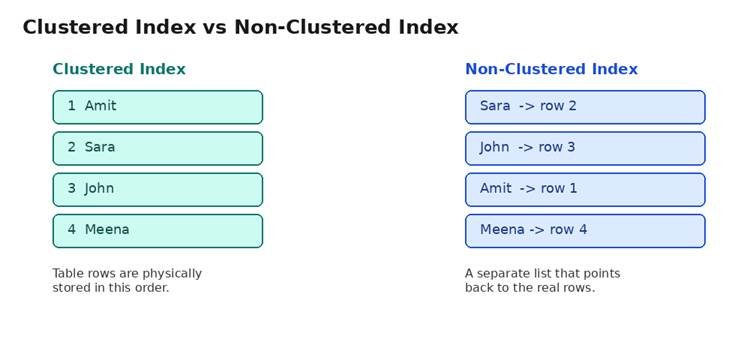
Figure 1: A clustered index stores the actual rows in order. A non-clustered index is a separate lookup list.
| Index type | Best used for |
| Clustered | Columns you search or sort by most often, like an ID or a date |
| Non-clustered | Columns used in WHERE or JOIN that aren’t the main sort order |
| Unique | Columns that must never repeat, like an email address |
| Full-text | Searching inside long text, like articles or product descriptions |
How SQL Server Handles a Query (Architecture)
Interviewers sometimes ask you to explain, in simple words, what happens after you hit “Run” on a query. Here is the short version.
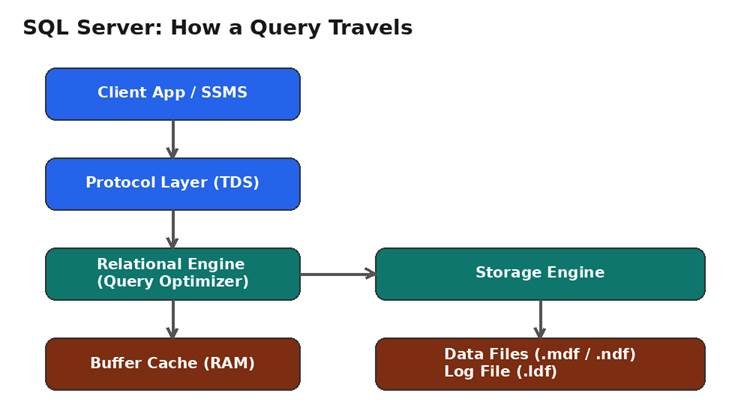
Figure 2: A query moves from the client, through the protocol layer, into the relational engine, and finally to the storage engine.
In short: your app sends the query, the relational engine figures out the best way to run it (this is called the query plan), and the storage engine actually fetches or writes the data — either from RAM (buffer cache) if it’s already loaded, or from the disk files if not.
Quick Comparison Tables
DELETE vs TRUNCATE vs DROP
| Command | What it does | Can you undo it? |
| DELETE | Removes chosen rows, one at a time | Yes, with ROLLBACK |
| TRUNCATE | Removes all rows at once, very fast | Only inside a transaction |
| DROP | Deletes the whole table, structure and all | No |
Tips To Crack The Interview
- Practice writing queries by hand, not just reading them. Typing builds muscle memory.
- Learn to read an execution plan — interviewers love asking about slow queries.
- Know at least one real example from your own project for every answer you give.
- Don’t memorise answers word for word. Understand the idea, then explain it in your own words.
- Brush up on basic math around indexes — how they make searches faster and writes slightly slower.
- If you don’t know an answer, say so honestly and explain how you’d find out. Interviewers respect that.
Frequently Asked Questions (FAQ)
Is SQL Server still worth learning in 2026?
Yes. It’s still one of the top databases used by large companies, especially those already using Microsoft tools like Azure and .NET. Job listings for SQL Server developers and DBAs are still common.
How long does it take to prepare for a SQL Server interview?
For a fresher role, two to three weeks of daily practice is usually enough if you already know basic SQL. For a senior or DBA role, plan on a longer prep covering performance tuning, backups, and high availability.
Do I need to memorise syntax exactly?
Not word for word. Interviewers care more about whether you understand what a command does and when to use it. Small syntax mistakes are normal and usually forgiven.
What is asked more — theory or writing queries?
Both, but expect a live query-writing round for almost every role, even junior ones. Practice writing joins, subqueries, and group-by queries on paper or a whiteboard, not just on a computer.
Is T-SQL different from normal SQL?
T-SQL (Transact-SQL) is Microsoft’s own version of SQL, used specifically in SQL Server. It includes everything in standard SQL plus extra features like variables, loops, and error handling.
Final Thoughts
SQL Server interviews are not about memorising a big list of definitions. Interviewers want to see that you understand how the database actually behaves — how it stores data, how it finds data quickly, and how it stays reliable when things go wrong.
Go through the questions above a couple of times, try them out on a real SQL Server instance if you can, and practice saying the answers out loud in your own words. That’s usually enough to walk into the interview feeling ready.